01 · 15/08/2023
2023-M08QFZI reported the return-to-work instruction and the declared incapacity. I found no specific reply reconciling the two.
Documented public complaint · Espírito Santo · Brazil
On 10 August 2026, the same IPAJM medical assessment produced two records: one marked “PERMANENTE — Sim” (permanent: yes), the other “PERMANENTE — Não” (permanent: no), valid for one year. Both oppose my return. Three days later, the refusal letter spoke of unfitness “de forma permanente” (permanently). By 31 October 2026, I had received no explanation of which record stands, and no final decision on my appeal.
I am a tenured mathematics teacher at SEDU/ES, hired through a public competition, with a master’s degree in informatics from UFES, and I say it plainly: I am able to work and I contest the incapacity attributed to me. I submitted a private medical report supporting my return. I have been out of my post since 2023; the retirement act was only published in June 2024, with retroactive effect, and my benefit was initially calculated at about 60% of average contributory earnings, with deductions that I question.
In 2023, the same State said two things: in February, a medical statement recorded total and definitive incapacity; in July, SEDU notified me to resume my post “or incur unexcused absences” (my translation). I do not need to guess anyone’s intent to show the effect: a teacher who asks to teach is still out of the classroom and, in the documents I received, the State has not said which duties he could not perform.
IPAJM is the pension institute for public employees of the State of Espírito Santo, Brazil. SEDU is the state education department. “Reversal” means returning to service from disability retirement. This is a first-person complaint about the reasons and delays of public bodies; it is not a court ruling.
These excerpts come from the supplementary appeal documents in case 2026.39.400959PA. I show only the fields needed. Both forms oppose an immediate return: the discrepancy does not authorise me to go back, but it does require an explanation.



Source: supplementary appeal annexes, pages 13, 15 and 14 respectively. Only the relevant fields are reproduced. The original documents are in Portuguese.
Article 12 of IPAJM Ordinance 011-R/2025 requires the medical report to state the validity date or the permanence of the invalidity. Article 14(III) exempts from reassessment anyone with an irreversible condition established in a report of permanent validity. The difference between the entries may affect the report’s validity and the reassessment arrangements. IPAJM should therefore explain the purpose and consequences of each entry.
Do the fields serve the same purpose in both documents? If so, why do they differ and which prevails? If not, what is the difference, and which record supports the refusal and the “permanently” in the letter? That is the explanation I demand from IPAJM.
Share this question on WhatsAppA medical statement recorded total and definitive incapacity. An inspection form of the same date recorded an extension of leave for an indefinite period, without ticking permanent incapacity.
Notice from the education department: “you must resume the duties of the post, or you will incur unexcused absences” (my translation).
The oversight office stated that the penalty in Ordinance 651-S “did not produce the practical effects provided for by law” (my translation), because IPAJM had already removed me from duty since 15/02/2023. Its statement concerns the penalty, not the order to return.
The context must be stated: the notice formed part of a SEDU disciplinary procedure, linked to Ordinance 651-S. But the oversight office’s own record shows that in July I had been away from duty, by IPAJM’s decision, since February. So why order me back? I reported this sequence to IPAJM on 15/08/2023 (2023-M08QFZ). By 31/10/2026, 1,173 days later, I had found no specific reply.
I began my public-service career on a fixed-term contract with SEDU itself. I later worked in education and technology at other institutions.
I took up a permanent mathematics teaching post at SEDU. In 2019 I requested advancement based on my master’s degree, case 87014580. That employment dispute is separate from this pension reversal application.
A medical statement recorded total and definitive incapacity. In July SEDU instructed me to resume duty or face unexcused absences. Its internal oversight office later stated that the sanction linked to Order No. 651-S had no practical effect because I was already on IPAJM leave; it did not specifically declare the return-to-duty instruction ineffective.
I informed IPAJM of the instruction to return. I found no specific reply in the records examined.
The retirement decision was published, with effect from February 2023. I question the interval between its effective date and publication, and its consequences for reassessment.
I applied for reversal of my disability retirement, supported by a private medical report dated 31 March 2026 favouring a return. That report does not bind the official medical board.
I complained to the state ombudsman about the delay. After follow-up requests and reopening of the complaint, an assessment was scheduled.
After the complaint, and 110 days after my application, IPAJM cited the two-year rule in Ordinance 011-R/2025.
The assessment took place 123 days after my application. Its records contain the validity entries shown above. The refusal letter is dated 13 August.
I lodged an administrative appeal against the refusal.
My medical records were made available 53 days after the assessment. I submitted supplementary appeal material in person on 9 October; its electronic registration followed on 13 October.
An informal message proposed reassessment. I requested formal instructions, without refusing any properly issued direction.
I had received no notification of a final appeal decision. This is the closing date of this account, not an automatically updated case status.
Transparency note: my April 2026 application was filed before the ordinary two-year mark after publication of the act, set by Article 3(II) of IPAJM Ordinance 011-R/2025 and reached on 24/06/2026. The assessment took place after that mark. My criticism concerns the content of the assessment and the decision on the appeal; it does not depend on claiming that the whole wait was an unlawful delay.
Since 2023 I have made 13 requests and submissions about my employment, medical, documentary and financial situation. The problem is not the number of filings: it is which questions still have no objective answer. I classified each one by comparing the request with the reply on record up to 31 October 2026. “No reply found” means that I found no communication addressed to me; it does not prove that no internal action occurred. Time runs to the reply shown or to 31 October 2026.
3 no reply found · 5 where the reply did not address the request · 2 vague · 2 partial · 1 still within reasonable time
It took about 62 minutes to reply “wait or supplement”. The communication of August 2023 has gone 1,173 days with no specific reply found.
I reported the return-to-work instruction and the declared incapacity. I found no specific reply reconciling the two.
I asked for the total amount and deduction percentage. The deduction was reduced to 10% on 22 May 2025, but I found no complete statement answering my request.
I asked which system, department and outstanding requirements applied. The reply named the system, said under review and gave telephone numbers; department and requirements remained unclear.
I requested a timeline, workflow, communications and documents. The reply listed departments and a temporary link; I continued to request an item-by-item response.
I asked about systems, traceability and retention. I received movement records and general information; retention and the conclusive reply remained unresolved.
I submitted 12 questions and requested the decision records. I was told to appeal; my medical records were supplied later. I still ask for answers to the questions.
I asked for confirmation of receipt and the responsible department. I found no specific reply.
I requested records, certification of non-existence and a consolidated reply. I was told to wait or supplement the appeal; the existence and supply of records remained unclear.
I asked whether the supplementary appeal had been sent for determination. I was told to wait or supplement it, without specific confirmation of forwarding.
I requested an estimated decision date. I found no reply by the reporting date.
I requested a statement and review of recovery deductions. Only ten days had elapsed at closing; this recent request is not presented as a proven delay.
In the ombudsman follow-up I asked about the start date, queue, forecast, review and appointment. An appointment was arranged; I regard the other points as only partly answered.
I requested access to 22 categories of records. The reply referred to a similar request and later supplied a case link; I continue to seek item-by-item answers.
This comparison does not claim that harassment occurred, and it attributes intent to no one. But the question is legitimate: since 2024, Espírito Santo has expressly prohibited moral harassment in the public service (Complementary Law 46/1994, Article 221(XXVII), added by Complementary Law 1,080/2024). In Assédio Moral no Trabalho, the Brazilian author Robson Zanetti presents the four phases described by the psychologist Heinz Leymann. Compare them with the facts recorded on this page.
2019: I requested advancement based on my master’s degree; four probation review cycles were formalised on a single day, with marks later revised.
Successive employment disputes with SEDU, one of them in court. Whether there were repeated hostile acts depends on a proper inquiry; I make no such claim here.
I told IPAJM about the order to return on 15/08/2023. After 1,173 days I had found no specific reply. There have been 13 requests since 2023, and for 3 no reply has been found.
I have been out of my post since 2023, on a benefit initially calculated at 60% of average contributory earnings. I asked to return, IPAJM refused and no decision on my appeal has been communicated.
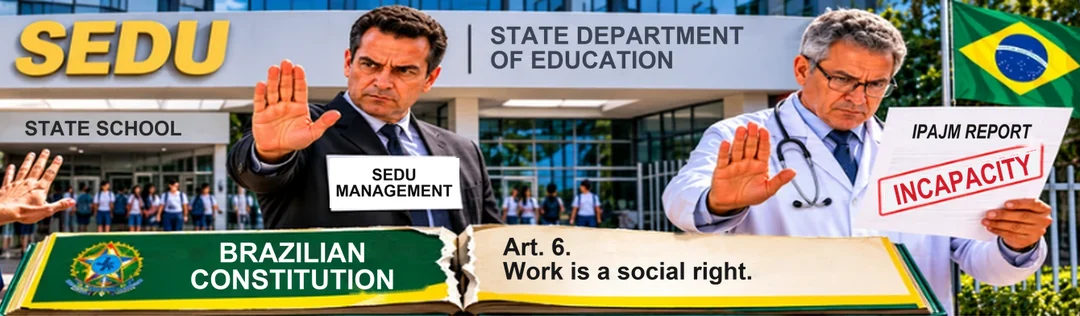
The book lists placement on invalidity among the means of the exclusion phase and notes its high cost to society. It also records, citing Leymann, that some bureaucratic treatment tends to reproduce the structures of harassment. It also cites, as an employment-law precedent, a decision of the Regional Labour Court of the 17th Region, in Espírito Santo, which treated providing work as the employer’s main obligation and “a source of the employee’s dignity” (my translation). It was an employment case, different from mine. Brazil’s Constitution lists work among social rights (Article 6), which does not guarantee automatic reversal but shows what is at stake.
What I am not saying: I do not claim that harassment occurred, nor do I attribute intent to anyone. The book itself distinguishes workplace conflict from harassment and requires, among other things, repeated abusive acts, intent and proof. That finding belongs to the competent authorities. What the documents show is the sequence and the effect: a tenured teacher asks to return to his post and remains out of the classroom.
Source: Robson Zanetti, Assédio Moral no Trabalho (e-book, in Portuguese), ch. 8, pp. 99–102, drawing on Heinz Leymann; also pp. 27–41, 63–64 and 87.
I am not claiming a post I never held. I am claiming the return to the public post I won by competition, from which I have been away since 2023.
The initial benefit is about 60% of average contributory earnings, not necessarily 60% of my final salary. I also question later recovery demands and the deduction calculations. The law allows overpayments to be deducted, and Brazil’s Superior Court of Justice protects a public employee’s objective good faith (Theme 1009): that is why I demand the statement, month by month.
There is also a public cost: the State continues paying a benefit to a qualified mathematics teacher seeking to return to the classroom. In the records communicated to me, I have not identified an individualised explanation of which duties of my position I would be unable to perform.
From where I stand, it feels like being held back: no post and reduced income. That is how I experience it, not a claim about anyone’s intent. Nor am I claiming that retirement prohibits every form of work. The restriction addressed here is returning to this post.
I hold degrees in mathematics teaching and computer science, and a master’s degree in informatics from UFES. My career includes SEDU, educational technology teaching in Vila Velha’s municipal school system and IT development for Vitória’s municipal administration.
I continued studying after retirement: I completed two postgraduate specialisation courses in 2025 and 2026, developed the TEPe educational records software, registered with Brazil’s INPI, and was ranked in a public selection process for mathematics teaching. Qualifications and output do not replace a medical assessment; they provide verifiable context about the public employee requesting a reasoned decision.
A filing, complaint or investigation does not establish wrongdoing or amount to a finding against anyone. Public reference numbers are listed in the detailed Portuguese dossier.
Official replies received will be published here, with date and source.
This is a public complaint written by the person concerned, not independent reporting. The excerpts allow readers to check a documentary discrepancy; the criticism and classifications are mine. Work-capacity decisions and appeal determinations belong to the competent authorities.
The full archive is not published: it includes health data, personal information and documents from proceedings with restricted access. This page shows selected excerpts and references so that the questions can be understood; it does not allow everything to be checked in full. The absence of a document here does not mean it does not exist, just as showing a document does not by itself prove wrongdoing. IPAJM, SEDU and the other bodies mentioned may provide explanations, documents or corrections, which will be identified by date and source.
Explanations, corrections and institutional replies can be sent through the site’s contact page or to admin@tecnologiaeducacao.com.br. Do not send medical records or sensitive data.
Read the detailed dossier in PortugueseExtended chronology, legal references and identifiers. The laws cited are Brazilian.Optional. No name or email. Answers come from volunteer visitors and do not represent the population.
Responsible party: the site author (contact in the footer). The survey records choices, date, language and a random identifier, without requesting a name, email or diagnosis. Response files contain no IP address; the hosting provider may retain technical logs. Participation cookie: up to 180 days. No automatic deletion is configured. Voluntary, non-representative results do not establish fault or medical fitness.
Sharing does not mean agreeing with me. It means asking the State to answer. Check the sources and keep the context.
Summary for checking, with links to official texts where available. All are Brazilian sources, in Portuguese. The reading applied to this case is mine; the decision belongs to the competent authorities.
Records as at 31 October 2026. Page last updated: 1 November 2026. Back to top